Planning
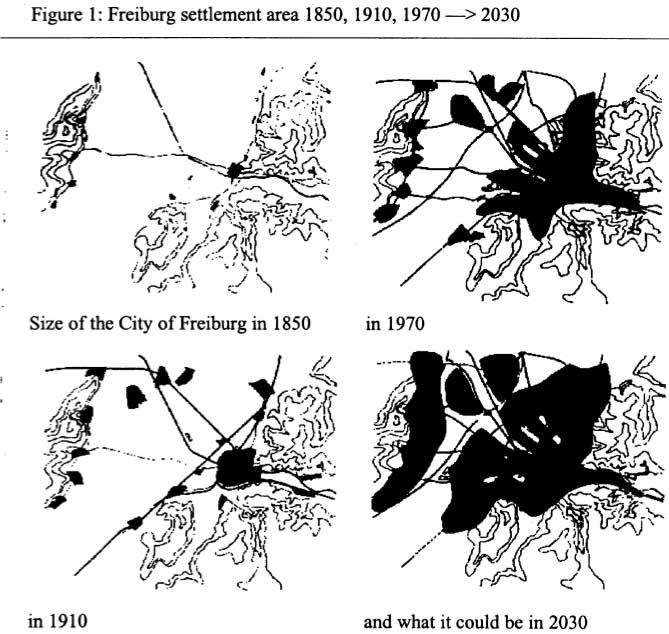
Freiburg is one of the only Germany cities with a growing population, and is Germany's fastest growing city. As a result, Freiburg is one of the few German cities in which strategic new development is a continuous component of planning policy. At its heart Freiburg is built on medieval building footprints, which have created a blueprint for integration for compact development with integrated residential, commercial and recreational facilities. Freiburg is nested into the foothills of the Black Forest, and there are concerns that the need for urban expansion in the coming decades will begin to encroach into sensitive natural areas. Concerns among environmentalists on this issue have driven planning regulations since the 1980's, and all new development and redevelopment in Freiburg is now required to take into account ecological factors, and must abide by stringent efficiency standards and be integrated into Freiburg's transportation web.
Two relatively new developments, Vauban and Reiselveld, exemplify how principles of sustainability are integrated into development decisions in Freiburg. Both Vauban and Rieselveld lie on the Freiburg's periphery, are integrated into Freiburg's tram network, and are widely recognized as "the world's most sustainable suburbs". Both Vauban and Rieselveld were constructed in the mid 1990's, generate the majority of their electricity themselves (through solar powers and on on-site biomass plant), and frequently produce enough electricity to sell back to the grid. Vauban and Rieseveld, which house 11,000 and 4,700 people, respectively, also have the lowest car ownerships in Freiburg at 150 vehicles per 1,000 people (compare with an average 430 vehicles per 1,000 residents in Freiburg proper, and 640 household vehicles per 1,000 residents in the US). Disincentives to car ownership, including integration into Freiburg's public transportation network, substantial parking fees, and encouraged car share programs help facilitate these trends.
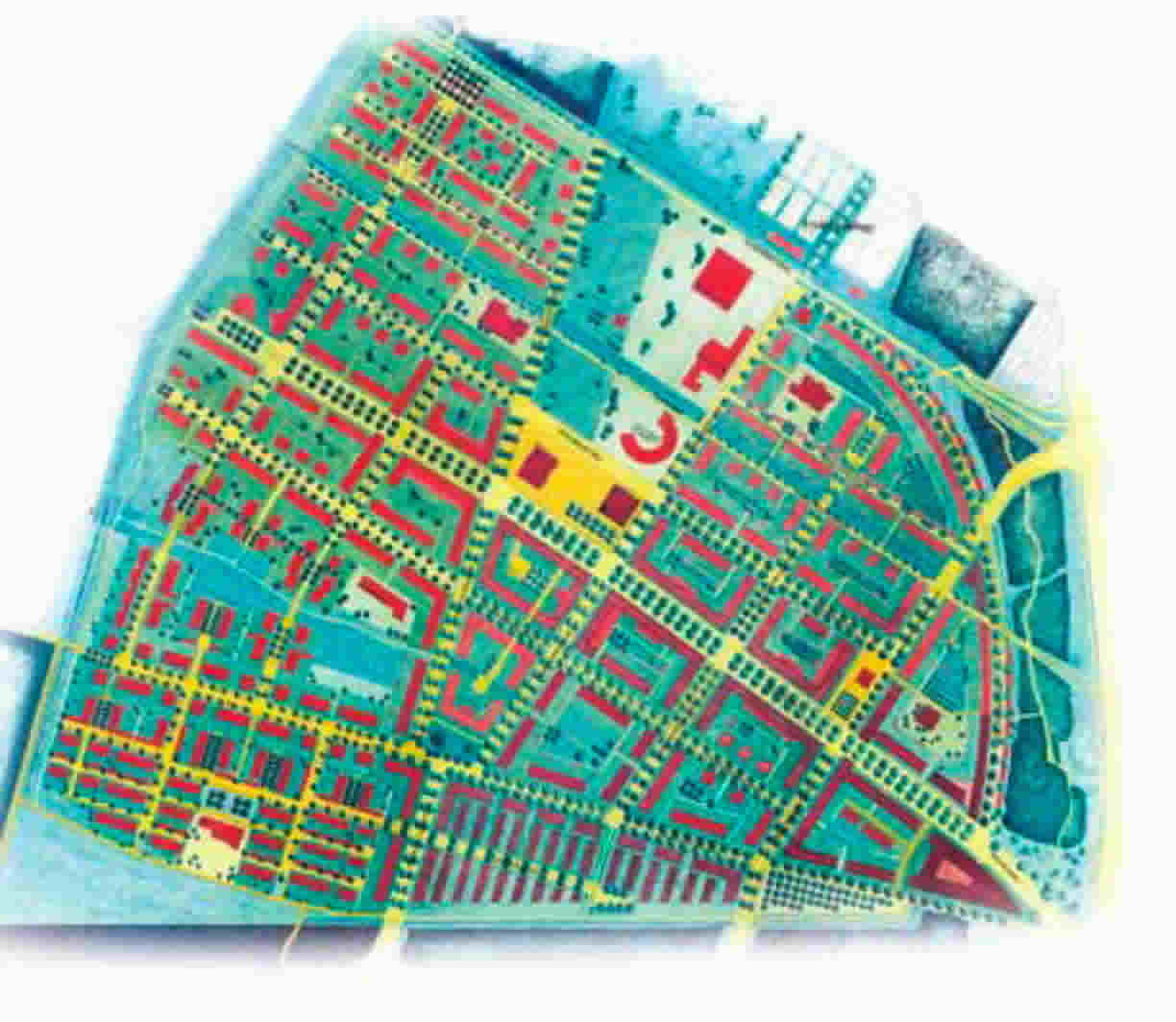
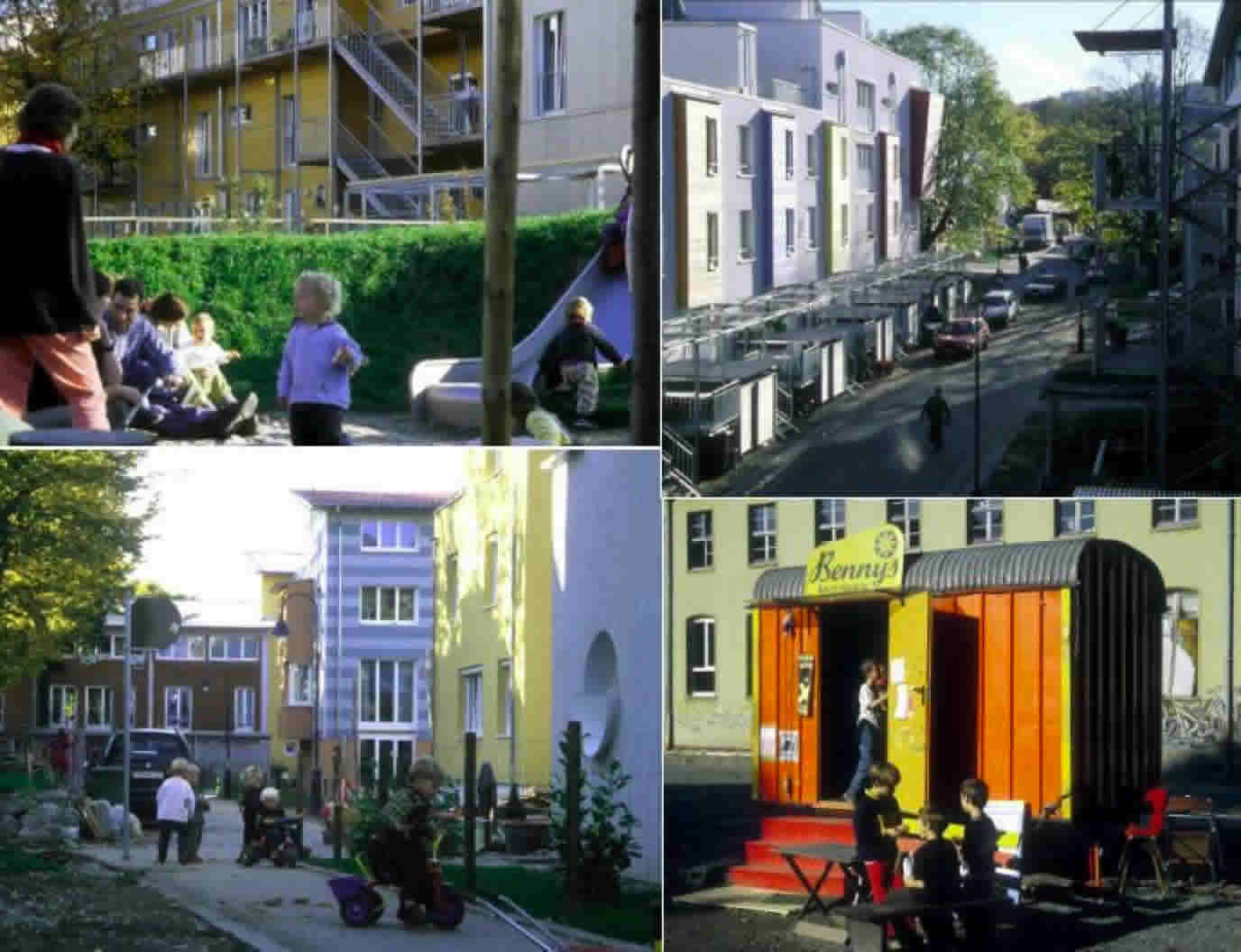
Rieselveld and Vauban
Photo Credits: City of Freiburg
Freiburg's car-free inner city
Photo Credit: Hilzberg Camping
Implementation
One unusual aspect of the implementation of these developments lies in the fact that both were commissioned by the City of Freiburg, and were ultimately built with substantial input by residents, planners, city officials and architects alike.
'In retrospect, "It would have been much simpler to give a big developer a piece of land and say, 'Come back five years later with a plan,' " says Roland Veith, the Freiburg city official in charge of Vauban. But the result is a "master plan of an ecological city ... unique in its holistic approach," says Peter Heck, a professor of material-flow management at Germany's University of Trier, pointing out that this was a community-wide effort involving engineers, politicians, city planners, and residents - not just an environmental group's pilot program...what makes Vauban unique, say experts, is that "it's as much a grass-roots initiative as it is pursued by the city council," says Mr. Scheurer. "It brings together the community, the government, and the private sector at every state of the game."'
-Isabelle de Pommereau (2007) New German Community Models Car-free Living